This recurring Real Estate feature is sponsored by The Eli Residential Team. Their mission is to guide, educate, and advocate for their clients through real advice, hands-on support, and personalized service. This week’s post is written by Carolanne Korolowicz.

In Arlington, the contention between urban development and environmental preservation is ever present. Citizens went to bat to save Arlington’s tree canopy during the Missing Middle debacle, there are environment-focus ballot measures almost every election, and plenty of local associations with a mission to preserve the county’s green landscape. But, did you know that debating over trees is actually an Arlington tradition? Before boundaries were even drawn, trees have been at the center of almost every development project.

On October 21, 1767, the stage was set by John Carlyle and Charles Alexander. The two prominent figures went to trial to dispute whose land (modern day Arlington and Alexandria City) was whose. Twenty-four witnesses gave their testimonies about the land boundaries defined by tree markers. Many of these witnesses were quoted mentioning the trees’ ages, whether they had been marked as line or corner trees, and the type of instrument used. With tree-defined boundary lines, the testimonies became a source of confusion rather than clarity.

In other historical accounts, it is clear that the DC-area forefathers viewed trees as part of the area’s heritage. A friend of Thomas Jefferson wrote, “Nothing affected Mr. Jefferson like this wanton destruction of the fine trees scattered over the (Federal) City grounds.” The friend also stated that Jefferson himself once said, “The unnecessary felling of a tree, perhaps the growth of centuries, seems to me a crime little short of murder.” As obvious by these statements, the conservation cause has always been one of great passion.

(A part of George Washington’s Oak Tree Displayed at The Glencarlyn Library, Photo: ArlingtonHistorical.com)

The acknowledgement of prominent trees has been documented over the centuries. George Washington’s survey oak in Glencarlyn being one of the first. Later in 1860, a large, anciently marked poplar tree was noted to be a landmark for the Cherrydale Neighborhood, but was cut down for the Washington and Old Dominion Railway in 1912. George Nicholas Saegmuller, an original owner of “Reserve Hill”– today’s Knights of Columbus Arlington Headquarters– planted a strip of evergreen forest from LIttle Falls Road to Old Dominion Drive as a homage to his homeland of Germany. Most importantly, the first tree to be given protection was one of the oldest oak trees of the Nation at the Grunwell Estate, located in Country Club Hills, in the late 19th century.

(A Champion Ash tree in Barcroft Park being measured, Photo: Arlington County)

Citizens acting as stewards of wildlife are deeply rooted in the makeup of Arlington. This symbiotic relationship remains today through the Forest and Natural Resources Commission’s Notable Tree Nominations. Since 1987, the volunteer-led program has awarded over 400 significant trees and their caregivers. In 2024, eleven trees were selected, including four on Fort CF Smith, six in North Arlington and one located on the corner of Columbia Pike and George Mason Drive. Though not legally protected, the status has proved helpful when communicating the importance of conservation during development projects.

What makes for a notable tree? The committee looks for these three items: size, neighborhood value, and uniqueness. Nominations are due every year on October 31st – so it’s not too late to submit! For legal protection, an application must be submitted for a ‘Specimen Tree’ through the Trees and Shrubs Ordinance. This designation requires tree conservation and protection if development of a site occurs. Violations result in a civil penalty of up to $2,500. Applications are due September 30th every year.

(A 2024 Notable Tree Winner: Deodar Cedar on Fort CF Smith, Photo: Arlington County)

As headbutting between developers and “tree-huggers” continues on, Arlington County has made efforts in favor of the area’s ecosystem over the decades. The citizens hold the power to improve these protections. Nominating trees for significance, or legal protection, is the easiest way to make a difference.

To quote the late local historian Eleanor Lee Templeman, “Although Arlington County has already lost a great deal of its forests through careless development of subdivisions, an awakened public concern over this priceless heritage will save a great deal of remaining beauty. Our stream valleys and palisades still possess true wilderness areas which must be preserved for posterity.” (Arlington Heritage: Vignettes of a Virginia County, 1959)


This recurring Real Estate feature is sponsored by The Eli Residential Team. Their mission is to guide, educate, and advocate for their clients through real advice, hands-on support, and personalized service. This week’s post is written by Val Connolly

When it comes to buying in Arlington, the options are exciting, and a little overwhelming! Do you picture yourself in a fully updated home, where modern kitchens, bathrooms, fixtures, and even new construction mean you can move in tomorrow with zero hassle? Or does a home with great potential catch your eye, where a fresh coat of paint, a new kitchen, updated flooring, or a few new fixtures lets you put your own stamp on the space while living in it?

Of course, each option comes with different costs. Move-in ready or newly built homes often carry a higher price tag upfront, but they save you time, effort, and renovation expenses later. Homes that need a little TLC may require more work (and patience), but they can be more affordable initially and offer opportunities to build equity through your updates.

From a realtor’s perspective, it’s all about balancing convenience, cost, and long-term value. Updated or new homes give you immediate comfort and less planning, while homes that need minor updates allow you to personalize, increase equity over time, and make your dream home truly yours.

Arlington’s neighborhoods offer the perfect mix of classic charm and modern upgrades, so whichever route you choose, you’re investing in a beautiful, vibrant community.

Which one would you go for—move-in ready or a home you can shape along the way?
Here are some active listings to explore both options!

THIS: Fully Updated & Ready to Move In (more…)


This regularly scheduled sponsored column is written by Eli Tucker, Arlington-based Realtor and Arlington resident. If you would like to work with Eli and his team in Northern Virginia and the greater D.C. Metro area, you can reach him directly at [email protected].

I’d like to share some exciting personal news with the ARLnow community… our family of three just became a family of four!

We welcomed baby girl Summer Tucker into the world in the early hours of September 21, the last day of Summer! We had the name picked out well before, so her birth date was a fun coincidence.

Summer is healthy, Mom is well, brother is excited, and we are enjoying every minute of it.

Baby girl Summer Tucker

If you’d like to discuss buying, selling, investing, or renting, don’t hesitate to reach out to me at [email protected].

We have access to the most pre and off-market listings across the DMV of any brokerage and are happy to share what’s available with anybody who asks.

Below are some of our team’s pre/off-market listings, details and additional listings available by request:

  • Ballston – 4BR/3.5BA+office/4,000 sqft – Four Townhouses (2026/2027) – 11th St N Arlington VA 22201
  • Falls Church City – 4BR/4.5BA/3,000+ sqft – End-unit townhouse (1995) – Rees Pl Falls Church VA 22046
  • Rosslyn – 2BR+den/2.5BA/2,000+ sqft – Condo (2021) – 1781 N Pierce St Arlington VA 22209
  • Highland Park/Overlee Knolls – 6BR/5.5BA/5,000+ sqft – Detached Single Family (2025) – 22nd Rd N Arlington VA 22205

Eli and his team believe that your real estate needs should be managed by advisors, not salespeople. Their mission is to guide, educate, and advocate for their clients through real advice, hands-on support, and personalized service.


This regularly scheduled sponsored column is written by Eli Tucker, Arlington-based Realtor and Arlington resident. If you would like to work with Eli and his team in Northern Virginia and the greater D.C. Metro area, you can reach him directly at [email protected].

Question: What market conditions do you expect through the rest of the year?

Answer: One of the best ways to use data in real estate is studying seasonal trends to understand expected market conditions during different times of the year, to maximize the results of your sale or purchase. Market activity, specifically the volume of listings coming to market and the speed at which homes go under contract, follows a predictable pattern.

This time of year, in the DMV, we can expect a post-Labor Day pop in listing activity and increase in the speed homes go under contract, followed by a sharp and continuous drop in both metrics, through the end of the year. Activity picks up once the calendar turns.

Expect Listing Activity to Drop Sharply Now to Year’s End

Only 18% of homes get listed for sale October-December, compared to 33.1% from March-May. The number of homes listed in the three months from March-May is almost the same amount listed in the five months from October-February.

If you have difficult criteria to meet, it might take a while to see a home for sale that works for you, especially after Halloween.

A graph with numbers and a line AI-generated content may be incorrect.

Homes Will Take Longer to Go Under Contract Through Year’s End

It isn’t just the supply side of the market that slows down in Q4, the speed at which homes go under contract will drop sharply from now through the end of the year, too.

While you may have more time to make offer decisions in Q4, don’t get too comfortable, more than 1/3 of homes go under contract within the first ten days on market and nearly 2/3 go under contract within thirty days.

Eli and his team believe that your real estate needs should be managed by advisors, not salespeople. Their mission is to guide, educate, and advocate for their clients through real advice, hands-on support, and personalized service.


This regularly scheduled sponsored column is written by Eli Tucker, Arlington-based Realtor and Arlington resident. If you would like to work with Eli and his team in Northern Virginia and the greater D.C. Metro area, you can reach him directly at [email protected].

Question: I’m planning to sell my home to a builder to be torn down, do you have any advice?

Answer: For many homeowners with older, smaller homes in expensive markets, selling to a builder is the easy and most profitable option when you’re ready to move. If you live in a home like this, you probably get hundreds of calls and letter from builders, investors, and real estate agents offering to buy your home as-is.

Here are six tips if you’re considering this option…

A brick house with a chimney Description automatically generated with low confidence

1. Don’t Overvalue Cash

The idea of somebody paying cash for your home sounds exciting and more reliable than somebody getting funds from a bank. “They pay cash” is one of the most common reasons I hear from homeowners explaining why they prefer selling to a builder.

The truth is that many builders don’t buy homes with a mountain of cash they have sitting around; they rely on strong banking relationships to finance their purchase with cash-like deals (the money is available quickly and easily).

The real value of cash is that a buyer can close quickly and does not require any bank approval, but a cash-like deal from a well-qualified buyer working with a great bank can often mirror this by removing any finance or appraisal contingency and closing as fast as the bank will allow (many can close in 2-3 weeks).

The contingency (or study period) structure and Earnest Money Deposit terms are more important than the funding source being a buyer’s private cash balance vs a trusted bank/lender. I would also argue that it’s more likely that an individual or builder cash-buyer will run into a cash crunch prior to closing than an established bank/lender.

2. Your Home May be Worth More to a Homeowner

It’s no secret how hard it is to find entry level homes these days. You may think that your current home with a small kitchen, old roof, and unfinished basement is only worth the land it sits on, but buyers are hurting for inexpensive homes, even if they need loads of improvements. Don’t assume that just because your home is small and dated that a builder is your only option.

Make sure you’re comparing builder offers to what you can get on the open market, taking into consideration other financial (e.g. differences in commission) and non-financial (e.g. timeline and showings) differences between the two routes. There may be little downside to testing the open market before committing to a builder, depending on your situation.

Your community will also appreciate your contribution to preserving the local tree canopy!

3. Builders Can Offer Attractive Rent-Backs

A rent-back means that you can live in your home after closing (aka after getting paid) for a specified period, usually for little or no cost, for months after a sale. For many sellers, this extra time is perfect for searching for your next home or apartment, with cash in-hand, or taking time to clear out decades of personal belongings.

A normal buyer can also offer a rent-back, and are often happy to, but if a home is being purchased using a mortgage for a primary residence, the buyer cannot offer a rent-back over two months. A builder, even if the funding comes from a bank, or cash buyer has no restriction on the length of rent-back. It’s well within reason to negotiate 3-4+ months of free or low-cost rent-back from a builder after closing.

4. Share in the Builder’s Profits

Jealous of the profit a builder will generate from building a new home on your lot? Rather than selling your home to a builder, consider negotiating an equity stake in the project and getting paid based on the sale of the new home. It’ll most likely take 16+ months longer to be paid and there’s more risk, but you can make a lot more than you would selling your existing home.

5. Delayed Settlements Can be Very Profitable

Most sellers want their proceeds as quickly as possible, but that may be costing them tens of thousands of dollars they could earn by agreeing to delay closing 4-6+ months (after going under contract). It takes at least 4-6 months for builders to get County-approved plans and start work and if a builder can avoid carrying the property during that time, the value of the deal goes up because their costs go down. So plan early to maximize the return on your home sale.

A picture containing building, outdoor, wooden, old Description automatically generated

6. Realtor Representation Can Be a Net Benefit

A direct sale without agents/commissions is one of the primary selling points builders offer and it’s certainly a good one, but representation and commissions come in many shapes and sizes that sellers can benefit from when selling to a builder. Benefits range from understanding how to measure the value/risk of contract terms like a study period or deposit, knowing what to negotiate for based on your needs/preferences, or effectively soliciting more bids to ensure you’re getting the best price.

Even though working directly with a builder can be simple, it’s important to remember that a builder’s core business is acquiring lots with favorable terms/prices, which runs counter to your best interests.

If you’d like to discuss buying, selling, investing, or renting, don’t hesitate to reach out to me at [email protected].

We have access to the most pre and off-market listings across the DMV of any brokerage and are happy to share what’s available with anybody who asks.

Below are some of our team’s pre/off-market listings, details and additional listings available by request:

  • Rosslyn 2BR/2BA/1,100 sqft – condo (2008) – 1800 Wilson Blvd Arlington VA 22201
  • Rosslyn 2BR+den/2.5BA/2,000 sqft – condo (2021) – 1781 N Pierce St Arlington VA 22209
  • Ballston – 4BR/3.5BA+office/4,000 sqft – Four Townhouses (2026/2027) – 11th St N Arlington VA 22201
  • Falls Church City – 4BR/4.5BA/3,000+ sqft – End-unit townhouse (1995) – Rees Pl Falls Church VA 22046
  • Rosslyn – 2BR+den/2.5BA/2,000+ sqft – Condo (2021) – 1781 N Pierce St Arlington VA 22209
  • Highland Park/Overlee Knolls – 6BR/5.5BA/5,000+ sqft – Detached Single Family (2025) – 22nd Rd N Arlington VA 22205

Eli and his team believe that your real estate needs should be managed by advisors, not salespeople. Their mission is to guide, educate, and advocate for their clients through real advice, hands-on support, and personalized service.


This regularly scheduled sponsored column is written by Eli Tucker, Arlington-based Realtor and Arlington resident. If you would like to work with Eli and his team in Northern Virginia and the greater D.C. Metro area, you can reach him directly at [email protected].

Question: What constitutes mortgage fraud that would cause somebody like Lisa Cook to lose their job?

Answer: After President Trump fired Federal Reserve Board of Governors member, Lisa Cook, over mortgage fraud, it’s fair to do a double take of your own mortgage decisions and make sure you have not slipped up and put yourself at risk. Mortgage fraud is a federal crime and can lead to jail, fines, loss of security clearance, and more.

For those worrying, I’ll review some of the basic principles on what constitutes mortgage fraud and why most people have nothing to worry about.

TL;DR Video Summary (2:26):

Why Would Somebody Commit Mortgage Fraud?

The main reason somebody would be enticed to commit mortgage fraud is to get themselves better loan terms including a lower interest rate, lower down payment requirement, or easier lending standards. It almost always comes in the form of telling the bank a property you’re buying will be used as your primary residence, when you actually intend to use it for another purpose (rental, vacation home, etc).

Loans on primary residences are less risky than loans on investment properties or vacation homes and thus get preferred lending treatment.

Banks Require Occupancy Deadline and Occupancy Period

Banks expect two things from borrowers if a loan is being classified as a primary residence:

  1. The Borrower must intend to move into the property within 60 days of settlement
  2. The Borrower must intend to live in the property as their primary residence for at least 12 months

The 60-day rule is why you won’t (shouldn’t) see seller rent-backs exceed 59/60 days when the buyer is purchasing with a primary residence mortgage because a 60+ day rent-back prevents the buyer from taking occupancy within the required 60 days.

It’s All About Intent

Notice that I bolded and italicized “intent” above because that is the most important factor in determining whether somebody has committed mortgage fraud. Banks require borrowers to sign and acknowledge at closing their intention to move into the property within 60 days and live there for at least 12 months, but not that they will do those two things. In other words, the bank does not require you to meet those requirements, they require that you intend to do so at the time of settlement.

Life changes often, quickly, and significantly and life changes do not mean somebody is committing mortgage fraud. Anything that occurs after settlement that changes your intended use of the property and results in you not meeting one or both of those requirements (60-day occupancy deadline and 12 months of occupancy) is legal, acceptable, and does not constitute mortgage fraud.

Job offer or job loss? You’re fine. Have a baby and need a different home? You’re fine. If you can justify your intent of meeting the requirements at the time of closing, you have nothing to worry about.

If your intended use of the property changes at any time prior to signing the closing paperwork, discuss it with your lender.

Do Investment Properties Need to be Investment Loans?

If you decide to keep your primary residence as an investment property after you move out, you do not need to convert the loan to an investment loan, it can remain a primary residence loan with the same terms; that is not mortgage fraud.

Even if you decide to move out in less than 12 months from settlement, for legitimate reasons, you won’t find yourself guilty of mortgage fraud, unless you are displaying a pattern of that behavior that suggests your intent at closing was to convert into an investment property in less than 12 months.

What About Renovations that Take More than 60 Days?

One of the trickier scenarios that come up is a buyer purchasing a primary residence, with a mortgage, who plans to do major renovations that will take more than 60 days to complete and thus they know they won’t be able to occupy the property within 60 days, but fully intend it to be used as a primary residence.

The vast majority of buyers choose to proceed with a mortgage classified as a primary residence in this scenario and it would be extraordinarily rare for somebody to be charged with mortgage fraud who fully intends to occupy the property as their primary home once the work is complete, but if you are a borrower who wants to take zero risk with the law, you may need to consider purchasing using an investment loan and then refinance into a primary residence loan once the work is completed. This is something you should discuss with your loan officer.

What Did Lisa Cook Do?

So, where does Lisa Cook, the Federal Reserve Board of Governors member who was recently fired by President Trump for mortgage fraud, fit into all of this? She is accused of obtaining two loans classified as primary home mortgages within two weeks of each other – one for a purchase in Michigan and the other for a purchase in Georgia. If a borrower purchases two homes in short sequence and knowingly claims them both as a primary home mortgage, that is considered mortgage fraud because one cannot intend to occupy both properties as a primary residence at the same time. I will leave the determination on whether Lisa Cook knowingly committed fraud to the courts…

If you are ever unsure about what constitutes mortgage fraud, the solution is simple: be honest and transparent with your loan officer and you should never find yourself in violation of the law.

If you’d like to discuss buying, selling, investing, or renting, don’t hesitate to reach out to me at [email protected].

We have access to the most pre and off-market listings across the DMV of any brokerage and are happy to share what’s available with anybody who asks.

Below are some of our team’s pre/off-market listings, details and additional listings available by request:

  • Rosslyn 2BR/2BA/1,100 sqft – condo (2008) – 1800 Wilson Blvd Arlington VA 22201
  • Rosslyn 2BR+den/2.5BA/2,000 sqft – condo (2021) – 1781 N Pierce St Arlington VA 22209
  • Ballston – 4BR/3.5BA+office/4,000 sqft – Four Townhouses (2026/2027) – 11th St N Arlington VA 22201
  • Falls Church City – 4BR/4.5BA/3,000+ sqft – End-unit townhouse (1995) – Rees Pl Falls Church VA 22046
  • Rosslyn – 2BR+den/2.5BA/2,000+ sqft – Condo (2021) – 1781 N Pierce St Arlington VA 22209
  • Highland Park/Overlee Knolls – 6BR/5.5BA/5,000+ sqft – Detached Single Family (2025) – 22nd Rd N Arlington VA 22205

Eli and his team believe that your real estate needs should be managed by advisors, not salespeople. Their mission is to guide, educate, and advocate for their clients through real advice, hands-on support, and personalized service.


This regularly scheduled sponsored column is written by Eli Tucker, Arlington-based Realtor and Arlington resident. If you would like to work with Eli and his team in Northern Virginia and the greater D.C. Metro area, you can reach him directly at [email protected].

Question: How much of a difference do schools make in the value of homes in Arlington?

Answer: I hope all parents, students, and teachers had a great first week back at school! If you enjoy reading my columns, I would appreciate your vote for top real estate agent in Arlington Magazine’s “Best Of Arlington 2026” poll. Use this link to vote, and don’t forget to include your other favorite local businesses and service providers. These recognitions mean a lot to local businesses.

Nothing drives home values like schools and for most buyers around here, that is based on the ten-point ratings scale on from GreatSchools.org. Let me be clear, this article is not meant to validate or challenge the quality of GreatSchools ratings, rather, it’s an acknowledgement of the weight the website’s ratings has on home buyer decisions and, therefore, home values.

Tips for Using Schools in Your Home Search

  • Families define a “good school” differently. Whether that’s test scores, socioeconomic diversity, language instruction, athletics, or a STEM focus think about what matters most to you and target schools that fit your values.
  • GreatSchools offers more than just a single rating, they offer component data as well. Dig deeper and look at the components of a school’s rating and review them based on what you value.
  • I know parents who have had both excellent and terrible experiences at top and low rated schools alike. The GreatSchools rating is not everything.
  • There are excellent public resources available for research including the Virginia Dept of Education’s School Quality Profiles and information nights for each school where you can see a school and interact with teachers first-hand
  • There are numerous message boards with loads of information about school operations like disability support, college readiness, and athletics
  • There are other private ratings websites like Niche.com and US News and World Report that offer different perspectives and ways of ranking schools
  • Arlington County has an A+ grade from Niche.com, ranking as the #2 school district in Virginia, just behind Falls Church City. Loudoun County ranks #4 and Fairfax County ranks #6 in Virginia, each with an A grade.

Analyzing Arlington Homes by GreatSchools Ratings

If school ratings are an important focus for you, you can use the table below to figure out what the most efficient use of your budget is to maximize your GreatSchools rating per dollar spent. In the table, I calculate the cost per GreatSchools rating point, based on the average price of a 3+ bedroom home in that school boundary.

The data uses sales since January 1 2024 of homes with at least three bedrooms, including condos (condos make up only about 5% of the total sales in this data set). Only neighborhood schools are included in this analysis, not the magnet/option schools.

  • The lowest cost per GreatSchools point elementary schools are Barcroft (7), Glebe (9), and Tuckahoe (9)
  • The lowest cost per GreatSchools point middle school is Gunston (7), followed closely by Kenmore (7)
  • The lowest cost per GreatSchools point high school is Yorktown (9)
  • The most expensive school to buy housing in on a total cost basis is Jamestown Elementary (8), but the most expensive per bedroom is Innovation Elementary (6)
  • The least expensive school to buy housing in on a total cost and price per bedroom basis is Abingdon Elementary (3)
  • Alice West Fleet (6) is the only school with a GS rating over 4 and average home price under $1M
  • Ashlawn Elementary has the most homes sold (158) with 3+ bedrooms since 2024 and Hoffman-Boston has the least (44)
  • It costs about 60% more to buy a 3+ bedroom homes in Arlington’s highest rated high school boundary (Yorktown, 9) compared to its lowest rated high school boundary (Wakefield, 4). The Wakefield HS boundary is the only high school market with an average sold price of a 3+ bedroom home under $1M.

A table with numbers and a number of people AI-generated content may be incorrect.

If you’d like some more personalized data run for you using home sales and GreatSchools ratings, you’re welcome to reach out to me at [email protected]. I’m happy to help.

If you’d like to discuss buying, selling, investing, or renting, don’t hesitate to reach out to me at [email protected].


We have access to the most pre and off-market listings across the DMV of any brokerage and are happy to share what’s available with anybody who asks.

Below are some of our team’s pre/off-market listings, details and additional listings available by request:

  • Rosslyn 2BR/2BA/1,100 sqft – condo (2008) – 1800 Wilson Blvd Arlington VA 22201
  • Rosslyn 2BR+den/2.5BA/2,000 sqft – condo (2021) – 1781 N Pierce St Arlington VA 22209
  • Ballston – 4BR/3.5BA+office/4,000 sqft – Four Townhouses (2026/2027) – 11th St N Arlington VA 22201
  • Falls Church City – 4BR/4.5BA/3,000+ sqft – End-unit townhouse (1995) – Rees Pl Falls Church VA 22046
  • Rosslyn – 2BR+den/2.5BA/2,000+ sqft – Condo (2021) – 1781 N Pierce St Arlington VA 22209
  • Highland Park/Overlee Knolls – 6BR/5.5BA/5,000+ sqft – Detached Single Family (2025) – 22nd Rd N Arlington VA 22205

Eli and his team believe that your real estate needs should be managed by advisors, not salespeople. Their mission is to guide, educate, and advocate for their clients through real advice, hands-on support, and personalized service.


This regularly scheduled sponsored column is written by Eli Tucker, Arlington-based Realtor and Arlington resident. If you would like to work with Eli and his team in Northern Virginia and the greater D.C. Metro area, you can reach him directly at [email protected].

Buyers now have more negotiating power, more choices, and…lower interest rates! Whether you are a new or experienced homeowner, come learn about the market and how our team positions buyers for success.

On Monday September 8, I’ll be hosting another Ask Eli Home Buyer Workshop with my business partner Jean Ropp and local Loan Officer, Matt Ropp, with Atlantic Coast Mortgage. Food and drinks will be provided!

The workshop is a free and will cover:

  • How to use data and strategy to maximize your home purchase
  • How to use market trends to your advantage
  • The latest on interest rates and mortgage programs/products
  • Common mistakes to avoid and some tips for success

Who is it for?

  • Any buyer type from first-time buyer to experienced buyers
  • Ready to purchase now or planning 12+ months out
  • Home buyers in Northern VA, DC, or the Maryland Suburbs
  • You or anybody you know who would benefit

Where and When?

  • Monday September 8 from 6-7:30PM
  • Arlington Central Library (1015 N Quincy St), Bluemont Room

Registration is now open and space is limited. Click the graphic below to RSVP. Bring your appetite and your home buying questions! I’d love to see you there. Feel free to email me at [email protected] with any questions about the event.

A poster for a house party AI-generated content may be incorrect.

If you’d like to discuss buying, selling, investing, or renting, don’t hesitate to reach out to me at [email protected].

We have access to the most pre and off-market listings across the DMV of any brokerage and are happy to share what’s available with anybody who asks.

Below are some of our team’s pre/off-market listings, details and additional listings available by request:

  • Rosslyn 2BR/2BA/1,100 sqft – condo (2008) – 1800 Wilson Blvd Arlington VA 22201
  • Rosslyn 2BR+den/2.5BA/2,000 sqft – condo (2021) – 1781 N Pierce St Arlington VA 22209
  • Ballston – 4BR/3.5BA+office/4,000 sqft – Four Townhouses (2026/2027) – 11th St N Arlington VA 22201
  • Falls Church City – 4BR/4.5BA/3,000+ sqft – End-unit townhouse (1995) – Rees Pl Falls Church VA 22046
  • Rosslyn – 2BR+den/2.5BA/2,000+ sqft – Condo (2021) – 1781 N Pierce St Arlington VA 22209
  • Highland Park/Overlee Knolls – 6BR/5.5BA/5,000+ sqft – Detached Single Family (2025) – 22nd Rd N Arlington VA 22205

Eli and his team believe that your real estate needs should be managed by advisors, not salespeople. Their mission is to guide, educate, and advocate for their clients through real advice, hands-on support, and personalized service.


This regularly scheduled sponsored column is written by Eli Tucker, Arlington-based Realtor and Arlington resident. If you would like to work with Eli and his team in Northern Virginia and the greater D.C. Metro area, you can reach him directly at [email protected].

Question: Is it a good time to buy a condo in Washington DC?

Answer: Unless you think that the Washington DC economy is heading for a death spiral, it could be a great time to acquire excellent value in the DC condo market.

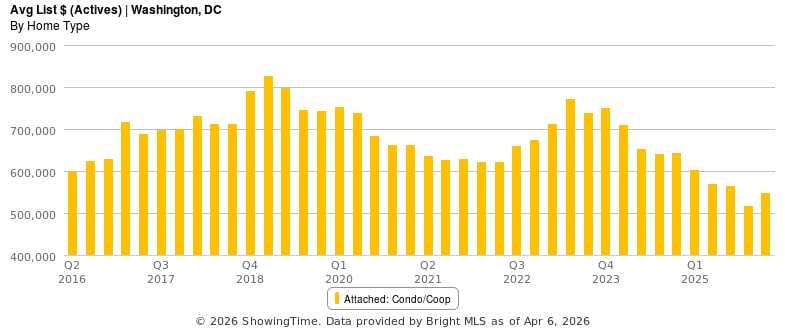
Asking Prices Are Lowest in 10+ Years

The average asking price of condos listed for sale in July was lower than it’s been at any time in the past ten years. In July 2025, DC condos were listed for an average price of $552,000. Prior to this summer, the lowest average monthly asking price for a DC condo over the past ten years was in August 2016 at $583,000, 5.6% higher than July 2025 asking prices.

The narrative improves slightly using median price, with a July 2025 median asking price of $450,000 compared to an August 2015 median asking price of $435,000.

In either case, average or median pricing, the data suggests buyers can buy DC condos at prices similar to 10+ years ago.

A graph of a number of yellow lines AI-generated content may be incorrect.

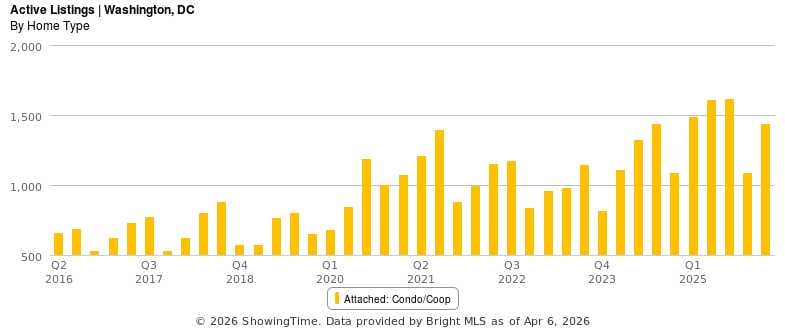
Buyers Have Nearly 3x More Options to Choose From

Buyers in DC will find nearly 3x more condos being offered for sale than the market has averaged over the past ten years, which means more opportunity to find the right property and find a seller ready to strike a great deal.

A graph with orange lines AI-generated content may be incorrect.

High Days on Market = Significant Buyer Leverage

The longer a property sits on the market, the more leverage buyers have to negotiate the price. The chart below shows the average sold price relative to the original asking price based on how long a property was on the market before going under contract, in Washington DC.

Homes that sell within the first ten days average above asking price. Once a home has been on the market for 30 days, buyers pick-up significant leverage, with an average of 5.7% and 7.6% off the original asking price for homes on the market 31-60 days and 61-90 days, respectively.

If you want to understand just how much leverage buyers have on DC condos right now, the days on market data tells the story:

· As of Monday August 18, there were 1,224 condos for sale in Washington DC

· Of those condos, the average time on market is 113 days and median time on market 82 days

· 996 (81.4%) have been on the market for 30+ days and 506 (41.3%) have been on the market for 100+ days

A graph of different colored bars AI-generated content may be incorrect.

Don’t Get Blindsided by DC’s Tenant-Landlord Laws

Washington DC is a very tenant-friendly jurisdiction and it’s important that you understand the requirements and limitations placed on landlords in DC if you plan to invest and rent property in the District. I’m far from an expert on DC tenant-landlord laws and property management, but highly recommend connecting with my colleague, Michael Hangemanole, if you have any questions or need Property Management/Rental services in Washington DC. He can be reached on his cell at (240) 483-7255 or by email at [email protected], and is more than happy to talk to any readers about DC property management, the rental market, and landlord-tenant laws.

If you’d like to discuss buying, selling, investing, or renting, don’t hesitate to reach out to me at [email protected].

Upcoming (pre-market) ERG Listings, Details and Additional Listings Available by Request

  • Ballston – 4BR/3.5BA+office/4,000 sqft – Four Townhouses (2026/2027) – 11th St N Arlington VA 22201
  • Falls Church – 5BR/3BA/2,170 sqft – Detached Single Family (1950) – Bolling Rd Falls Church VA 22042
  • Falls Church City – 4BR/4.5BA/3,000+ sqft – End-unit townhouse (1995) – Rees Pl Falls Church VA 22046
  • Yorktown – 6BR/6.5BA/6,000+ sqft – Detached Single Family (2026) – N Greencastle St Arlington VA 22207
  • Rosslyn – 2BR+den/2.5BA/2,000+ sqft – Condo (2021) – 1781 N Pierce St Arlington VA 22209
  • Highland Park/Overlee Knolls – 6BR/5.5BA/5,000+ sqft – Detached Single Family (2025) – 22nd Rd N Arlington VA 22205

Eli and his team believe that your real estate needs should be managed by advisors, not salespeople. Their mission is to guide, educate, and advocate for their clients through real advice, hands-on support, and personalized service.


This regularly scheduled sponsored column is written by Eli Tucker, Arlington-based Realtor and Arlington resident. If you would like to work with Eli and his team in Northern Virginia and the greater D.C. Metro area, you can reach him directly at [email protected].

If you enjoy reading my columns, I would appreciate your vote for top real estate agent in Arlington Magazine’s “Best Of Arlington 2026” poll. Use this link to vote, and don’t forget to include your other favorite local businesses and service providers. These recognitions mean a lot to local businesses.

Question: How has buyer agent compensation changed since the laws changed last year?

Laws Changed One Year Ago

You probably recall hearing all about the class-action lawsuits and settlements last year that made it illegal for sellers and brokers to offer buyer agent compensation through the MLS. In fact, many argue that the law makes it illegal for sellers and brokers to offer a set buyer agent compensation at all. I wrote about the changes here, if you want a refresher.

The laws went into effect one year ago, in August 2024. They were a huge deal within the industry and captured months of news headlines.

The Mechanics Changed, The Market Has Not

In October, I wrote an article clarifying some misunderstandings and shared my observations that little had changed in the market, with most transactions including seller-paid buyer agent compensation.

After a full year, including a spring market (albeit less competitive than usual), the results of the settlement have caused little change for consumers and in the industry.

  • The Mechanics Changed: Prior to August 2024, in nearly all transactions, the seller agreed to a set compensation for the agent representing them and an agent representing the buyer. The buyer agent compensation was entered into the MLS listing and became enforceable. Now, any seller-paid buyer agent compensation is enforced through the sales contract and must be agreed to during buyer-seller negotiations. If it’s not in the contract, it’s not payable.
  • The Market Has Not: Prior to the new laws, nearly all transactions included seller-paid buyer agent compensation and in 2022 the average buyer agent comp in Arlington was 2.54% with over 80% of transactions including 2.5 seller-paid buyer agent comp. Based on our team’s experience, brokerage data, and regional/national surveys the market is still operating in a very similar manner, with sellers covering buyer agent compensation in the vast majority of transactions and the average hovering around 2.5%.

In May 2025, Redfin published some great data on this (charts below), showing that the average buyer agent compensation had dropped from 2.51% in Q1 2023 to 2.4% in Q1 2025. Much less of a drop than many expected. Their data does show that the average commission percentage is about one-third percent less for homes sold for $1M+ than those sold for under $500k.

Their data does not indicate what percentage of these transactions/fees were paid by the seller, but their sub-header in the same article states “most sellers are still paying buyer agent commissions” which is exactly what I’ve seen over the past 12 months, what our brokerage of ~450 agents in the DC Metro has found surveying every transactions, and what I’ve heard from numerous lenders, title attorneys, and appraisers who have insight into thousands of regional transactions.

A graph of sales AI-generated content may be incorrect.

A graph of sales AI-generated content may be incorrect.

We Have a Data Transparency Problem

One of the trade-offs made with these new laws was losing transparency and reporting on seller-paid buyer agent commissions. Prior to 2024, when this information was entered into the MLS, all agents, brokers, appraisers, etc could easily pull buyer agent commission data for individual transactions or for an entire market (like I used to do for Arlington).

Without transparency into how much seller-paid buyer agent commission was included in a transaction, we run into challenges with property valuations aka “comparables.” While studies and experience suggest that a given sale most likely included 2.5% seller-paid commission, that’s probably true for about 2/3 of transactions these days and the others vary from less to more to none. So, the housing marketplace lost valuable insight into market values when we removed buyer agent comp from the MLS because sale prices will vary if the seller is paying 2.5-3% to a buyer agent vs nothing.

Note: other MLS’s may track this but Bright MLS (second largest in the country, covers most of the Mid-Atlantic) does not have a good method for doing so.

Frankly, I’m shocked the banks haven’t had more to say about this because their appraisers are missing information that contributes to a 0-3% shift in valuations that they use to make lending decisions.

My understanding of why they don’t want to collect this data is they don’t want individual buyer-seller decisions to be influenced by what the rest of the market is doing. I sympathize with that position, but there are plenty of other ways to access and understand what the rest of the market is doing, so consumers and agents who want the data will get it anyway. It’s also important for consumers/agents to know what competing listings are offering and what decisions past sellers have made that lead to success in their market. The loss of data transparency/reporting is a significant loss for the market.

If you’d like to discuss buying, selling, investing, or renting, don’t hesitate to reach out to me at [email protected].

Eli and his team believe that your real estate needs should be managed by advisors, not salespeople. Their mission is to guide, educate, and advocate for their clients through real advice, hands-on support, and personalized service.


This regularly scheduled sponsored column is written by Eli Tucker, Arlington-based Realtor and Arlington resident. If you would like to work with Eli and his team in Northern Virginia and the greater D.C. Metro area, you can reach him directly at [email protected].

Question: How has the rental market performed so far in 2025?

If you enjoy reading my columns, I would appreciate your vote for top real estate agent in Arlington Magazine’s “Best Of Arlington 2026” poll. Use this link to vote and don’t forget to include your other favorite local businesses and service providers. These recognitions mean a lot for local businesses.

Rental Prices Across Arlington Continue Higher

Local job uncertainty and economic headwinds were no match for rental prices in Arlington so far in 2025, with the average price of renting an apartment (condo), townhouse/duplex, and detached home all up and competition high across all three property types.

Over the past five years, the average rent price in Arlington is up 27.3% across all property types and 25.2% on a price per square foot basis. So far in 2025, the average price of all rentals is up 1.2%, but the average price per square foot is up 6.9%, which is likely a better reflection of actual rental price increases in 2025.

You can see my mid-year analysis on the for sale market for detached homes and condos, here and here.

Highlights and Data Table

Here are some highlights from the data table (keep in mind that 2021-2024 includes 12 months of data, but 2025 is just 7 months of data):

  • The average rent for an apartment (condo) is up 5.9% compared to last year and up 29.6% over the past five years
  • The average rent for a detached home is up 2.1% compared to last year and up 23.4% over the past five years
  • The average rent for a townhouse/duplex is up 2% compared to last year and up 22.8% over the past five years
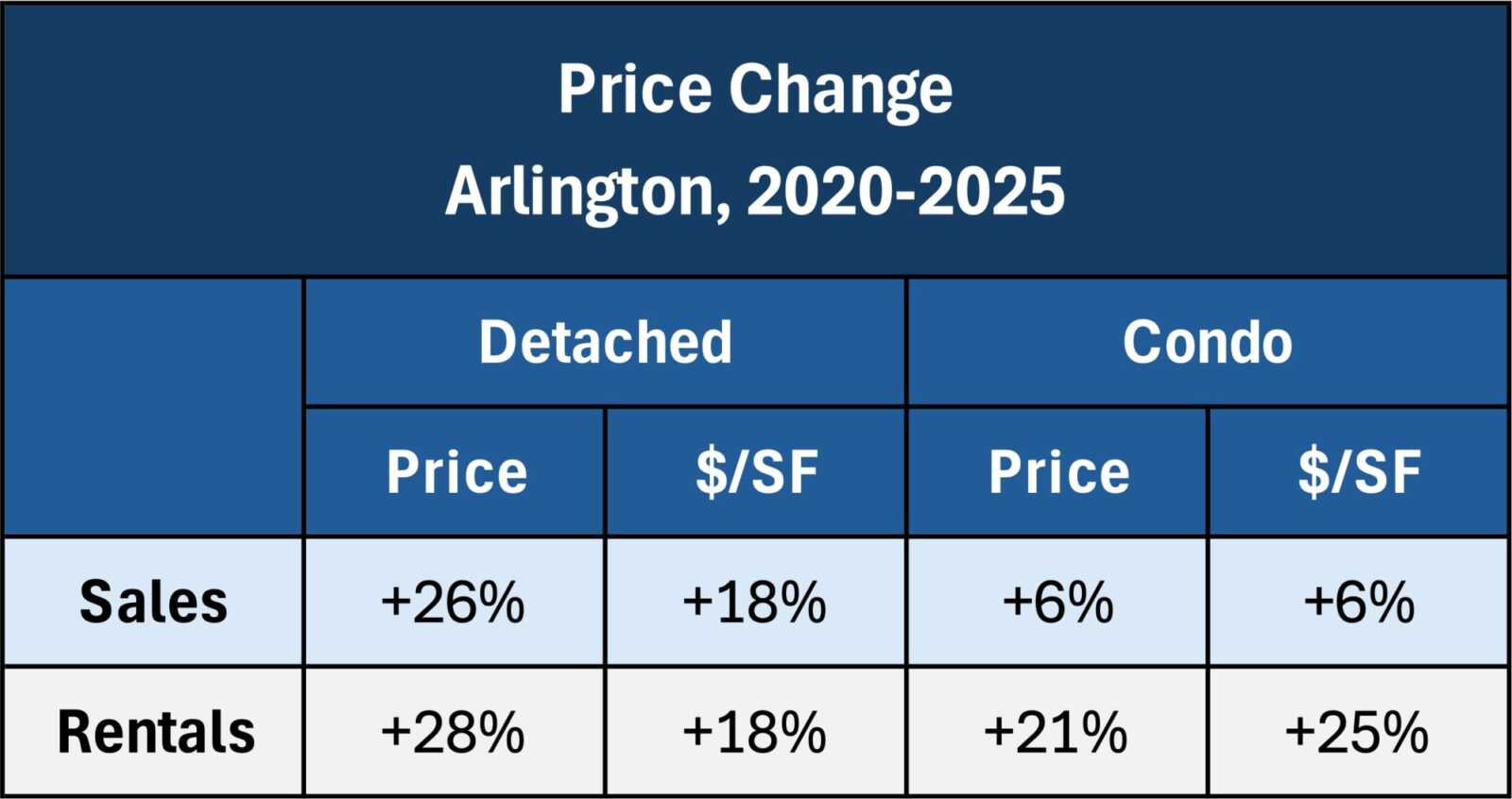
  • The five year increase in average rent for apartments (condos) and detached homes is much higher than the increase in average price to purchase a condo (6%) and detached home (15.5%) over the past five years
  • While the average price of renting in North Arlington is about 16% higher than is South Arlington, the rate of annual rent growth is similar across both regions of the county
  • Renting a detached home or townhouse/duplex was moderately more competitive than renting an apartment (condo), with nearly 50% of detached and townhouse/duplex properties renting within ten days on market, compared to just over one third of apartments

A table with numbers and percentages AI-generated content may be incorrect.

About the Data

The data above is rental data from the MLS in Arlington over the last five years. Note that very few commercial apartment buildings list in the MLS so this data is limited to non-commercially owned rentals (for apartments, that is mostly individually owned condos).

Further, it’s difficult to say what percentage of non-commercially owned properties go through the MLS for rent but I would guess that it’s about half of rented apartments (condos), but likely a majority if detached and townhouse properties. Despite the limited data set, we still have more than enough information available through the MLS to generate outputs that represent the true rental market.

Upcoming (pre-market) ERG Listings, Details and Additional Listings Available by Request

  • Falls Church – 5BR/3BA/2,170 sqft – Detached Single Family (1950) – Bolling Rd Falls Church VA 22042
  • Falls Church City – 4BR/4.5BA/3,000+ sqft – End-unit townhouse (1995) – Rees Pl Falls Church VA 22046
  • Arlington Ridge/Aurora Hills – 3BR/2.5BA/2,450sqft – Detached Single Family (1961) – S Grove St Arlington VA 22202
  • Yorktown – 6BR/6.5BA/6,000+ sqft – Detached Single Family (2026) – N Greencastle St Arlington VA 22207
  • Rosslyn – 2BR+den/2.5BA/2,000+ sqft – Condo (2021) – 1781 N Pierce St Arlington VA 22209

Eli and his team believe that your real estate needs should be managed by advisors, not salespeople. Their mission is to guide, educate, and advocate for their clients through real advice, hands-on support, and personalized service.


This regularly scheduled sponsored column is written by Eli Tucker, Arlington-based Realtor and Arlington resident. If you would like to work with Eli and his team in Northern Virginia and the greater D.C. Metro area, you can reach him directly at [email protected].

TL;DR Video Summary (2:42):

Question: How has the Arlington condo market performed in the first half of 2025?

Answer: The condo market is more susceptible to downturns in the housing market because condo buyers can almost always find a suitable alternative by renting an apartment, if buying loses its appeal. With high interest rates and uncertain local economic conditions in the first half of 2025, the Arlington condo market suffered a loss in value, unlike the detached single-family market, and is having one of its worse years in the past two decades.

Prices and Competition Down in the First Half

Let’s look at the performance of Arlington’s condo market in the first half of 2025 compared to the first half of the previous four years:

  • The average price of a condo fell by 10%, to just over $508,500, and the average $/SqFt fell by 4%
  • The median price of a condo fell by 7.5%, to $439,000
  • Demand fell sharply with just 39% of condos selling within the first ten days on market and just 39% selling for at or above the asking price
  • After significant price gains in 2024, seller optimism was high heading into 2025 and the initial asking prices reflected that. Low demand led to substantial discounts off the initial asking price, with condos selling for an average of 5.3% below the original ask, compared to about 1% each if the past four years.
  • Most of the losses seem to come from the two-bedroom condo market, where the average price dropped by 7%, compared to a 1% drop in the one-bedroom market

(more…)


View More Stories